jurisdiction risk
When the Constitutional Ground Shifts: What Hungary's 17th Amendment Tells In-House Teams About Jurisdiction Risk
A Constitutional Moment With Commercial Consequences
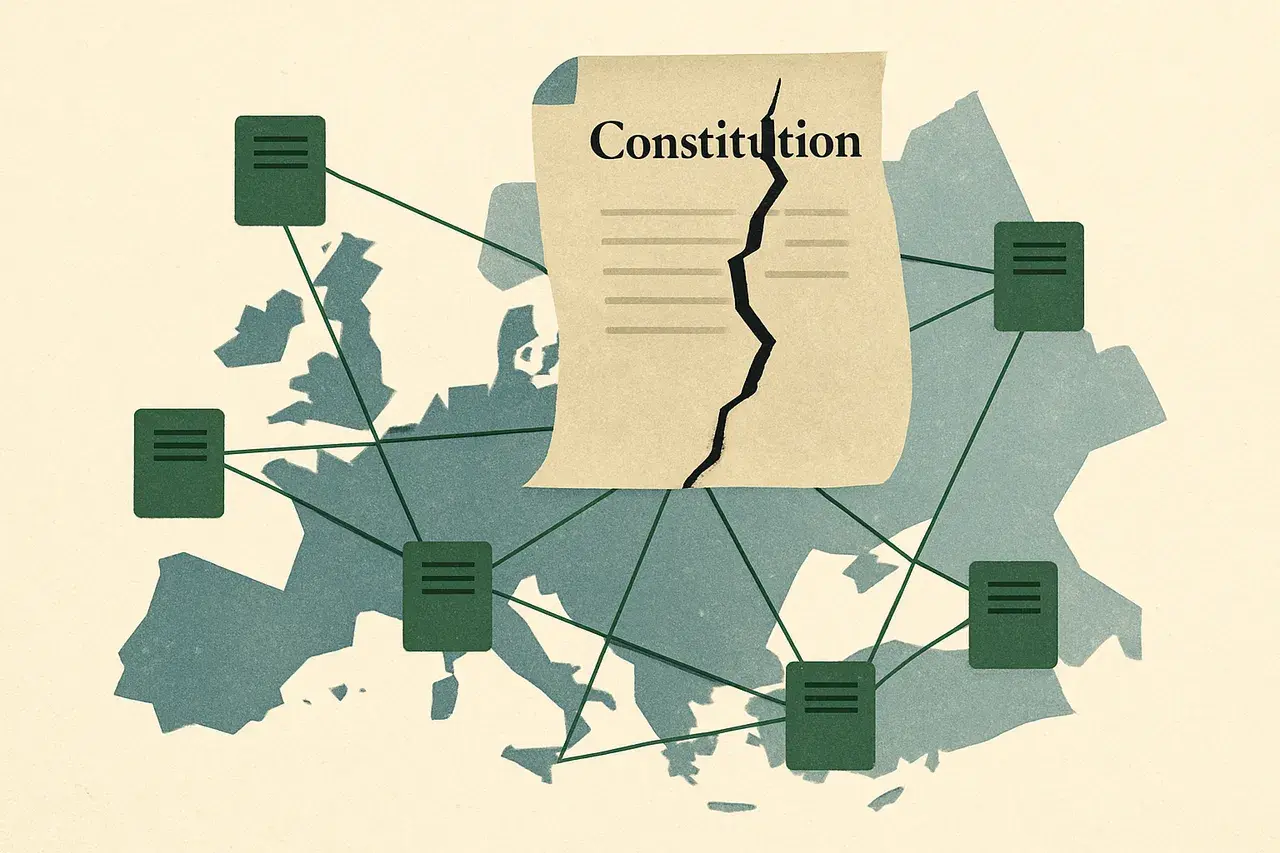
On 13 July 2026, the Hungarian Parliament passed the 17th Amendment to the Fundamental Law, ending the term of President Tamás Sulyok by legislative fiat. The Verfassungsblog analysis describes this as "an extraordinary measure," justified by the President's alleged partiality and failure to check earlier illiberal constitutional developments. Whatever one thinks of the political merits, the episode belongs to a wider pattern that in-house counsel cannot afford to treat as background noise.
Constitutional ruptures of this kind are not purely academic events. They alter the environment in which contracts are performed, enforced and interpreted. When the governing law of an agreement is a jurisdiction undergoing rapid constitutional change, the assumptions baked into that contract at signature may no longer hold at the point of dispute.
Why Governing Law Clauses Deserve More Scrutiny Than They Receive
The governing law clause is, in most contract negotiations, a late-stage formality. Parties spend hours on payment terms and indemnity caps, then wave through a choice of Hungarian, Polish or Romanian law because it mirrors where the counterparty is incorporated. That approach was always imprecise. In the current European environment, it is becoming genuinely risky.
Hungary's constitutional trajectory over the past fifteen years has seen the judiciary restructured, the media landscape consolidated and now a presidential removal by amendment. Each of those changes has some bearing on what it means to litigate or arbitrate under Hungarian law, or to rely on a Hungarian court for interim relief. In-house teams need processes that flag this kind of accumulated constitutional drift, not just the standard country-risk indicators that focus on macroeconomic data.
What AI-Assisted CLM Can and Cannot Do Here
This is precisely the territory where a well-configured AI contract management platform earns its place. Reading contracts from your side of the transaction, an AI CLM can surface every agreement in your portfolio where Hungarian law governs, where Hungarian courts have exclusive jurisdiction, or where a Hungarian state entity is the counterparty. That extraction task, done manually across thousands of documents, is slow enough that the risk remains invisible until it crystallises.
But the platform's value goes further than extraction. Adira is built to understand the law of the jurisdiction it is working in, which means it can apply current legal context when drafting or reviewing clauses rather than recycling boilerplate that was accurate two constitutional cycles ago. If a force majeure clause, a stabilisation clause or an expert determination mechanism needs to be calibrated to a jurisdiction with an uncertain judicial independence picture, the drafting should reflect that uncertainty explicitly rather than assuming a stable rule-of-law environment.
What AI cannot do is make the political judgment call for you. The question of whether to accept Hungarian governing law on a ten-year infrastructure contract is ultimately a commercial and strategic decision. Technology surfaces the exposure; counsel and the business own the decision.
Practical Steps for Portfolio Triage
For any in-house team with European exposure, Hungary's 17th Amendment is a sensible prompt to run a targeted portfolio review. The triage should ask three questions.
First, which contracts have Hungarian governing law or jurisdiction clauses, and what is the term and value of those agreements? Short-term, low-value contracts carry different risk profiles from long-dated concessions or financing arrangements.
Second, do those contracts contain dispute resolution mechanisms that bypass domestic courts, such as ICC or VIAC arbitration seated outside Hungary? If so, the constitutional volatility is substantially mitigated, though not eliminated, since recognition and enforcement of awards still requires engagement with local courts.
Third, are there renewal or renegotiation windows approaching that would allow governing law or dispute resolution provisions to be revisited? Amendment cycles are expensive, but a renewal is a natural moment to modernise risk allocation without reopening the entire commercial deal.
The Broader Lesson for European Contract Strategy
Hungary is the most visible example of rapid constitutional change within the EU, but it is not the only one. Scholars and practitioners are watching developments in several member states where judicial independence, constitutional court composition and the scope of executive power are all contested. The EU's own rule-of-law conditionality mechanisms have not resolved these tensions, and the pace of domestic constitutional change can outstrip any Brussels-level response.
For law firms advising on cross-border transactions and for in-house teams managing complex European portfolios, the operational implication is clear. Jurisdiction risk analysis needs to become a live, recurring process rather than a one-time exercise at deal inception. Contract intelligence tools that track portfolio exposure by governing law and alert teams to relevant legal and constitutional developments are no longer a luxury feature. They are part of responsible portfolio management in a period when European constitutional stability can no longer be assumed.
See how Adira drafts in your voice and reads contracts from your side.
Explore the showroomWorking through a contract like this? Weave is Adira’s free tool to read, mark up, and connect any contract in your browser — no account needed.
Try Weave — freeRelated reading