contract drafting
The Dramatist's Lesson: Why Cutting Is the Hardest Skill in Contract Drafting
The Playwright Who Knew About Boilerplate
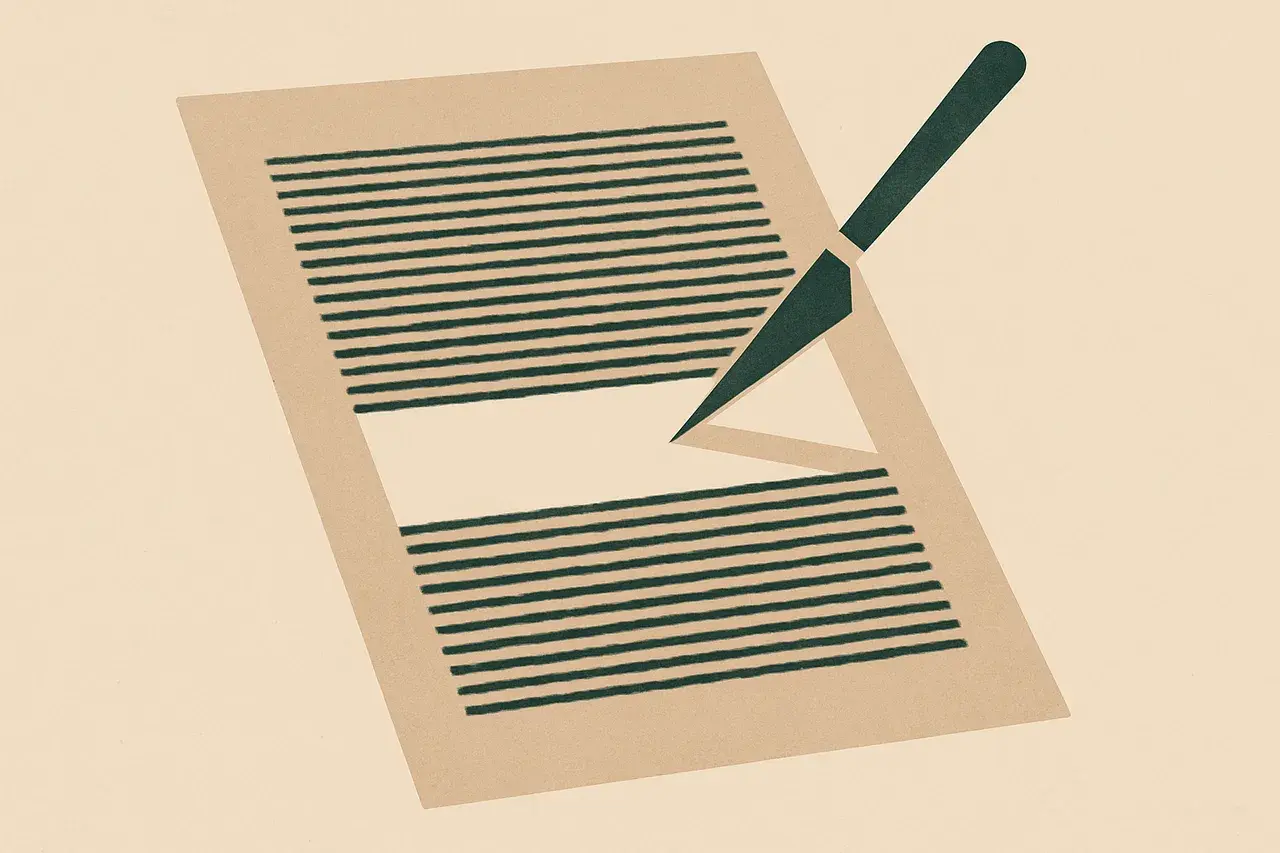
A German legal scholar recently drew a line between law and theatre that is worth pausing on. In theatre, she observes, you must think about the audience constantly: remove the overlong monologues, the unnecessary scenes, the confusing subplots. The discipline is called dramaturgy, and its primary tool is deletion.
Contracts, by contrast, tend to grow. Each negotiation cycle deposits another clause. Each incident in the business adds a new carve-out. Each cautious lawyer appends one more definition. The document that emerges is less a focused instrument and more a sedimentary record of every anxiety anyone ever had about the transaction. Nobody reads it end to end. Nobody is supposed to.
That is a problem, and it is a more serious one than most legal teams acknowledge.
What Verbosity Actually Costs
The standard defence of lengthy contracts is that length equals protection. More words mean fewer gaps, fewer gaps mean fewer disputes. This is largely a myth.
Research in plain-language contracting consistently finds that longer agreements produce more ambiguity, not less, because clauses interact in unintended ways and parties cannot hold the whole document in mind when performing obligations. Courts in English and Scottish jurisdictions regularly apply the contra proferentem rule against the party who drafted an obscure provision, meaning that verbosity can actively undermine the drafter's position.
There is also a transactional cost. An unnecessarily complex contract slows negotiation, raises external counsel fees, and defers the moment at which the commercial relationship can actually begin. For in-house teams measured on cycle time and cost per contract, every surplus recital is a line item on the wrong side of the ledger.
And there is a subtler cost: the contract that nobody reads is the contract that nobody follows. Operational teams ignore obligations buried in paragraph fourteen of schedule three. Finance teams miss payment conditions wrapped in defined-term cross-references. The document fails at its primary function, which is to coordinate behaviour.
Where AI Can Help and Where It Can Mislead
Generative AI tools have made it easier to produce large volumes of contractual text quickly. That is, on balance, a capability worth having. But it creates a specific risk: the path of least resistance is to generate more rather than less, because more feels comprehensive and feels safe.
A well-designed AI drafting system should push in the opposite direction. At Adira, our drafting logic is built around a company's own voice and its established clause library, which means the model is always comparing a proposed provision against what the organisation has already decided it needs. Redundant clauses surface as redundant. Provisions that duplicate obligations already handled elsewhere are flagged. The output is leaner by design, not by an afterthought.
Critically, because Adira reads contracts from the client's side and knows the governing law of the jurisdiction, it can distinguish between a clause that looks surplus but carries jurisdictional weight and one that genuinely adds nothing. A limitation of liability clause that appears duplicative under English law may be doing essential work under a civil law system where default rules operate differently. Cutting intelligently requires that kind of context. Cutting without it produces gaps that are worse than the original verbosity.
The Dramaturgy of a Good Contract
The theatrical analogy is useful precisely because dramaturgy is not about minimalism for its own sake. A three-hour play can be perfectly taut. A one-page contract can be a mess. The question is whether every element is doing work proportionate to its length.
Applied to contracts, this means asking a series of disciplined questions. Does this clause change what either party would otherwise be entitled to do or claim? Does it address a risk that is realistic given the commercial context? Is it expressed in the most direct way available in this jurisdiction's legal register? If the answer to any of those questions is no, the clause is a candidate for deletion or consolidation.
In-house teams that build this discipline into their template governance process, rather than treating it as a one-time spring clean, accumulate a significant structural advantage. Their contracts close faster, their counterparties push back less, and their operational colleagues actually read the documents they sign.
A Practical Starting Point
For teams that want to apply this thinking immediately, a useful exercise is to take the most-used contract template in the portfolio and audit every clause against one question: what happens if this clause is not here? If the answer is "nothing changes because the law implies the same position anyway" or "nothing changes because another clause already covers this," the clause should go.
This is not a radical proposition. It is the minimum standard of craft that any editor, director or dramatist would apply to their own work. Legal drafting is writing. The rules of good writing apply to it. Cutting is not a concession. It is a skill, and for most organisations it is an underdeveloped one.
See how Adira drafts in your voice and reads contracts from your side.
Explore the showroomWorking through a contract like this? Weave is Adira’s free tool to read, mark up, and connect any contract in your browser — no account needed.
Try Weave — free