contract drafting
Cut to the Chase: What Theatre's Editing Rule Teaches Contract Drafters
The Director's Red Pen
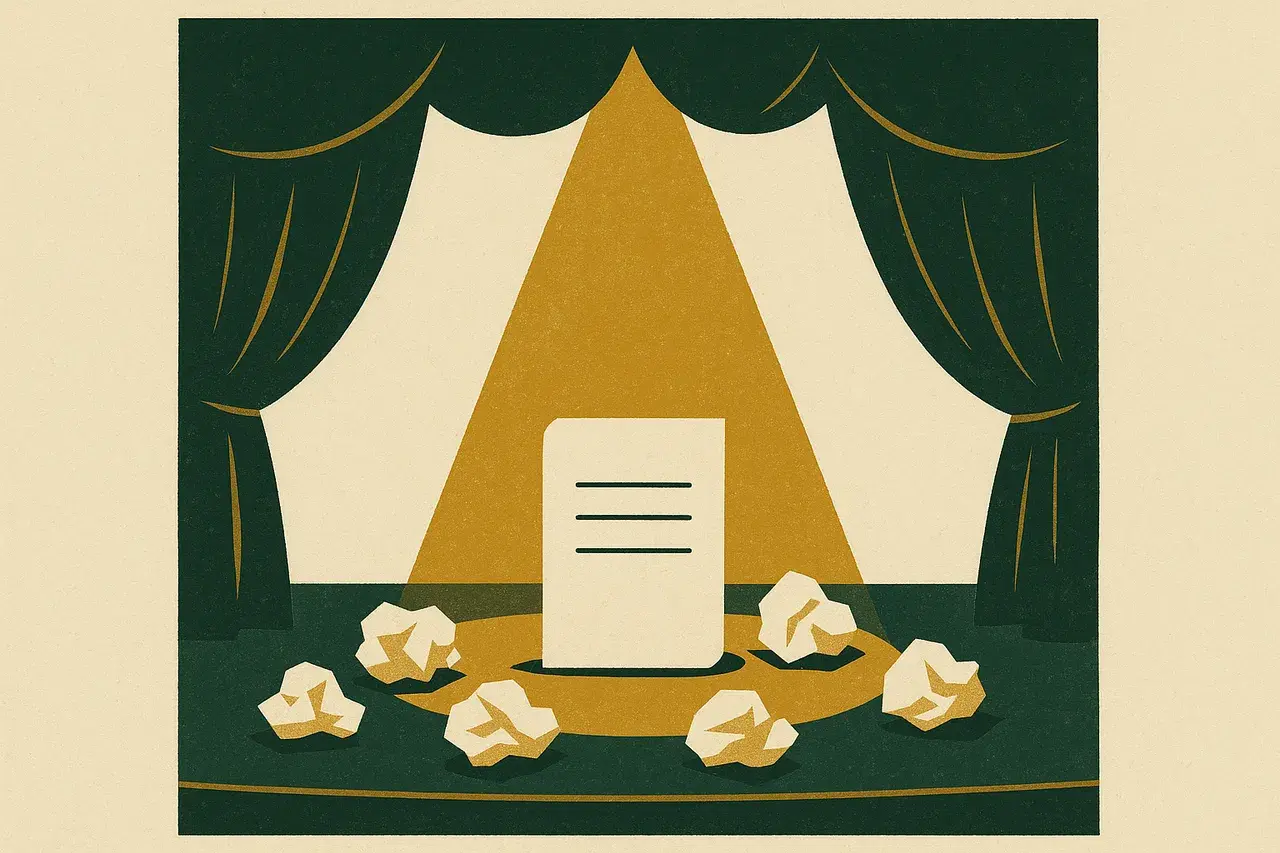
Theatre practitioners have a blunt editorial rule: if a scene does not advance the story, it goes. Overlong monologues, redundant exposition, subplots that lead nowhere, all of it ends up on the cutting-room floor before opening night. The audience's attention is finite and the playwright who forgets that loses the room.
Legal drafters would do well to borrow that instinct. Contracts are not repositories for every conceivable risk the legal team has ever encountered. They are working documents that two or more parties must read, understand, negotiate, and eventually perform. When the document loses the reader, it loses its practical purpose entirely.
Why Contracts Accumulate Dead Weight
The problem is structural. Most commercial contracts are built on precedents that were themselves built on earlier precedents. Each generation of lawyers adds protective language after a deal goes wrong, a regulator raises a concern, or a partner firm imports a clause from a different jurisdiction. Very rarely does anyone remove anything.
The result is what experienced contract reviewers privately call the archaeological contract: layer upon layer of clauses from different eras, some of which now contradict each other, several of which address risks that are no longer legally or commercially relevant, and a handful of which have been superseded by statute in the governing jurisdiction. Nobody owns the document as a whole. Everyone owns their own addition to it.
For in-house teams under pressure to turn around agreements quickly, this accumulation is not merely aesthetically unpleasant. It is a direct operational cost. Every unnecessary recital, every cascading definition that is defined once and used nowhere, every boilerplate warranty that contradicts the limitation of liability clause three pages later, adds time to review cycles and uncertainty to negotiations.
Reading from Your Side, Not the Middle
One reason contracts stay bloated is that conventional drafting tools treat a document as a neutral object. A word processor does not know whose interests a particular indemnity serves. A standard clause library does not flag that a given warranty is standard market practice in England and Wales but unusually onerous under German law.
Adira is built on a different premise. When it reads a contract, it reads from the client's side. It understands the jurisdiction the agreement is governed by, and it knows what a clause actually means for the party sitting across from it. That positional awareness changes the editorial calculus entirely. A clause that looks routine in isolation may be a material concession in context. A definition that seems harmless may extend liability far beyond what the commercial team intended.
This is the digital equivalent of the theatre director sitting in the stalls rather than standing on the stage. Perspective matters. You cannot edit well from inside the text.
Drafting in the Company's Own Voice
There is a second editorial failure that goes beyond length: the failure of voice. Many commercial contracts sound as though they were written by no one in particular, because in a sense they were. They are assemblagess of clauses from different firms, different eras, and different legal traditions, stitched together without any consistent register or drafting style.
This matters more than it might appear. When a contract is litigated or arbitrated, ambiguity is resolved by reference to what the parties intended. A document that is internally inconsistent in tone and structure is harder to interpret purposively. Courts in England, for instance, have repeatedly noted that surrounding commercial context informs contractual construction, but that exercise is complicated when the document itself sends mixed signals about what the parties were trying to achieve.
Adira drafts in the company's own voice, which means that the output is not a patchwork of imported precedent but a coherent document reflecting how that business actually communicates and what it actually intends. The editorial discipline is baked in from the first draft rather than imposed in a late-stage review.
The Business Case for Brevity
Shorter, clearer contracts are not just aesthetically superior. They close faster, generate fewer queries from counterparties, reduce the scope for interpretive disputes, and are more likely to be read by the people who have to perform them. Research from the International Association for Contract and Commercial Management has consistently shown that contract complexity is one of the primary drivers of value leakage in commercial relationships.
The theatre director who cuts a twenty-minute monologue to five minutes does not weaken the play. Done well, the cut makes every remaining line carry more weight. The same is true of a limitation clause stripped of its redundant carve-outs, or a termination provision that states its conditions clearly rather than hiding them in a cross-referenced schedule.
Cutting is a skill. It requires knowing what the document is for, who will read it, under what law it will be interpreted, and what the drafting party actually needs it to do. Those are precisely the questions that Adira is designed to answer before the first word is written.
See how Adira drafts in your voice and reads contracts from your side.
Explore the showroomWorking through a contract like this? Weave is Adira’s free tool to read, mark up, and connect any contract in your browser — no account needed.
Try Weave — free